DMFTwDFT3 Documentation
DMFTwDFT3 is an open-source, user-friendly framework to calculate properties of strongly correlated materials (SCM) using DFT+DMFT (Dynamical Mean Field Theory) with a variety of different DFT codes. It currently supports VASP, Siesta, and Quantum Espresso.
Note
DMFTwDFT3 brings major updates to its Python-2 predecessor, DMFTwDFT, with a focus on supporting modern compute architectures including a Python-3 ecosystem, Intel oneAPI LLVM compilers, and MacOS compatibility. Hereafter, DMFTwDFT3 will be referred to as DMFTwDFT for brevity.
Strongly Correlated Materials and DMFT
Electronic correlations in materials give rise to a wide range of emergent phenomena through the intricate interplay among electron spin, charge, orbital degrees of freedom, and lattice distortions. In systems containing localized \(d\) or \(f\) electrons, such as transition-metal and rare-earth compounds, strong electron-electron interactions lead to remarkable properties including magnetism, high-temperature superconductivity, colossal magnetoresistance, and metal-insulator transitions.
While Density Functional Theory (DFT) has been extraordinarily successful in describing the electronic structure of weakly correlated materials, its static mean-field treatment of electron interactions often fails to capture the physics of strongly correlated materials. In particular, the localized nature of \(d\) and \(f\) orbitals results in significant many-body effects that are inadequately described by conventional exchange-correlation functionals.
Dynamical Mean-Field Theory (DMFT) has emerged as one of the most successful approaches for treating strong electronic correlations beyond the DFT framework (see Georges et al., Rev. Mod. Phys. 68, 13 (1996) and Kotliar et al., Rev. Mod. Phys. 78, 865 (2006)). By incorporating dynamical local correlations through a many-body Green’s function formalism, DMFT captures both the itinerant and localized character of electrons.
In DMFT, the lattice problem is mapped onto a self-consistent interacting impurity model (Anderson impurity model), which is solved numerically using advanced impurity solvers such as Continuous-Time Quantum Monte Carlo (CTQMC; see Haule, Phys. Rev. B 75, 155113 (2007)). This framework enables an accurate description of many-body fluctuations that are absent in static mean-field approaches.
The combination of DFT and DMFT provides a powerful first-principles methodology for studying strongly correlated materials. In a typical DFT+DMFT workflow, the DFT Kohn-Sham states are projected onto a correlated subspace, often represented using Maximally Localized Wannier Functions (MLWFs; see Pizzi et al., J. Phys.: Condens. Matter 32, 165902 (2020)). The resulting low-energy Hamiltonian serves as the basis for the DMFT calculations, where local electronic interactions are treated explicitly. In the DMFT cycle, the impurity problem is solved self-consistently, yielding a frequency-dependent self-energy that captures the many-body effects. This converged DMFT self-energy and density matrix are then fed back into the DFT calculation, and the process is iterated until full charge self-consistency is achieved.
The framework enables the characterization of both weakly and strongly correlated materials through a fully charge-self-consistent DFT+DMFT implementation. In addition, DMFTwDFT provides a library mode for computing the DMFT density matrix, allowing seamless integration with external DFT packages and facilitating the incorporation of charge-self-consistent DFT+DMFT capabilities into existing electronic-structure codes.
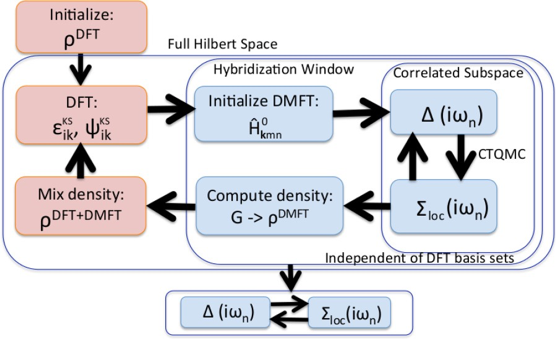
Flow diagram of a charge self-consistent DFT+DMFT calculation implemented using the MLWF basis set. Ref: Park et al., Phys. Rev. B 90, 235103 (2014).
Why DMFTwDFT?
DMFTwDFT offers the following,
Conveniently interfaces with multiple DFT codes through the MLWF
wannier90library.A flexible Python-based interface reduces the amount of user experience and parameter tuning required to perform DFT+DMFT calculations of strongly correlated materials.
The implementation has been tested with density of states and band structure calculations for correlated materials including \(LaNiO_{3}\), \(SrVO_{3}\), and \(NiO\).
The library mode links the module for computing a DMFT density matrix and updating a charge density within DFT loops without significant DFT source-code changes to enable full-charge self-consistent DFT+DMFT calculations.
DMFTwDFT is organized around a simple command-line workflow; DMFT.py runs the main DFT+DMFT or Hartree-Fock calculation, postDMFT.py handles post-processing, and the utilities directory provides additional plotting, analysis, and diagnostic tools.